Twelve weeks ago, you started something.
You had a blank screen, a quiet hope, and probably more than a few doubts. You didn't know what a pillar post was. The words "SEO," "affiliate link," and "email sequence" may have felt like a foreign language. The idea of filming yourself on camera and putting it on YouTube may have seemed somewhere between terrifying and completely absurd.
And yet — here you are.
You have a blog. A real one, with real posts, real readers, and real affiliate links generating real commissions. You have an email list of subscribers who chose to hear from you. You have a YouTube channel with videos that are working for you right now, while you sleep, while you cook dinner, while you live your life. You have a Pinterest presence driving traffic to your content every single day.
You have built something that most people only ever talk about building.
Take a moment to let that land. Genuinely. Because what you have done in twelve weeks is not small. It is the foundation of a real, sustainable, income-generating online business — and most people never get this far.
But this post is not about looking back. It is about looking forward.
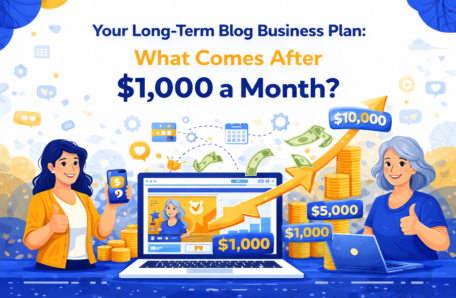
Because $1,000 a month is not the destination. It is the proof of concept. It is the moment your blog stops being an experiment and starts being a business. And once you have a business — a real one, with proven income streams and a growing audience — the question becomes: what do you want to build with it?
That is what this post is about.
Not just the tactics of what comes next — though we will cover those in detail. But the bigger picture. The long-term vision. The kind of blog business that does not just generate income but generates meaning, freedom, and a legacy that reflects exactly who you are and what you stand for.
By the end of this post, you will know:
✅ The three income levels beyond $1,000 a month — and what each one requires
✅ How to build a blog business that runs without burning you out
✅ When and how to create your own signature product or course
✅ How to build a community around your brand — not just an audience
✅ The long-term content strategy that keeps your blog growing for years
✅ How to think about your blog as a legacy — not just a side income
Let's build your long game.
Quick Navigation:
- The Three Levels Beyond $1,000 a Month
- Building a Business That Doesn't Burn You Out
- Your Signature Product: The Next Level Income Leap
- From Audience to Community: The Loyalty Multiplier
- The Long-Term Content Strategy
- Protecting and Diversifying Your Income
- The Blog Business That Reflects Who You Are
- Your Legacy: What Are You Really Building?
- Your Long-Term Blog Business Plan Template
- Your Action Plan This Week — and Beyond
The Three Levels Beyond $1,000 a Month
Let's start with the numbers — because having a clear picture of what is possible, and what each level requires, makes the path forward feel concrete rather than abstract.
Here are the three income levels most successful bloggers progress through after reaching $1,000 a month — and what each one typically looks like in practice.
Level 1: $1,000–$3,000 a Month — The Validation Stage
What it looks like:
At this level, your blog is generating consistent income from two to three sources — typically a combination of affiliate marketing, display advertising, and early email list monetization. Your traffic is growing steadily. Your email list has 500–2,000 subscribers. Your YouTube channel is gaining momentum.
What it requires:
- Consistent weekly content publishing (blog + YouTube)
- Active Pinterest and SEO strategy
- A growing, engaged email list
- Two to four active affiliate programs
- Display ads installed (Google AdSense or early Mediavine)
What it feels like:
This is the stage where blogging stops feeling like a gamble and starts feeling like a real business. Your income is not yet life-changing — but it is consistent, it is growing, and it is proof that everything you have built is working.
The primary focus at this level: Volume and consistency. Keep publishing. Keep growing your list. Keep showing up on YouTube. The compounding effect of consistent content creation is just beginning to accelerate.
Level 2: $3,000–$5,000 a Month — The Momentum Stage
What it looks like:
At this level, your blog has become a meaningful income source — one that could realistically replace a part-time job or significantly supplement your retirement income. Your traffic has reached 25,000–75,000 monthly pageviews. Your email list has 2,000–5,000 subscribers. You have likely launched your first digital product. Your YouTube channel has 2,000–10,000 subscribers.
What it requires:
- A signature digital product (ebook, course, or template pack) generating consistent sales
- Mediavine or a premium ad network installed
- A well-optimized email sales funnel
- A library of 75–150 published blog posts
- A YouTube channel with 50–100+ videos
- Consistent backlink building and SEO optimization
What it feels like:
This is the stage where your blog begins to feel like a genuine business — one with systems, recurring revenue, and real momentum. The income is meaningful. The audience is loyal. The work feels purposeful.
The primary focus at this level: Depth over breadth. Rather than simply publishing more content, focus on making your existing content better, your products more valuable, and your audience relationships deeper.
Level 3: $5,000–$10,000+ a Month — The Authority Stage
What it looks like:
At this level, your blog is a full-time income source — one that generates more than most traditional jobs, with complete flexibility over your time, your schedule, and your creative direction. Your traffic has reached 75,000–200,000+ monthly pageviews. Your email list has 5,000–15,000+ subscribers. You have multiple digital products. Your YouTube channel has 10,000–50,000+ subscribers. You are recognized as a genuine authority in your niche.
What it requires:
- Multiple digital products at different price points
- A premium course or coaching program ($197–$997+)
- A highly optimized email sales funnel with multiple sequences
- Brand sponsorships and partnerships
- A team — even a small one (a virtual assistant, an editor, a Pinterest manager)
- A clear, distinctive brand that stands out in a crowded niche
What it feels like:
This is the stage where your blog business has become something larger than yourself — a brand, a community, and a platform with genuine influence. The income is life-changing. The impact is real. And the work, while still demanding, is deeply fulfilling.
The primary focus at this level: Leverage and systems. You can no longer do everything yourself — and you shouldn't try to. The focus shifts to building systems, delegating tasks, and creating products and programs that generate income without requiring your direct time for every dollar earned.
Building a Business That Doesn't Burn You Out
Here is something the blogging industry does not talk about enough: burnout is the number one reason bloggers fail to reach their income potential.
Not lack of talent. Not a bad niche. Not poor strategy. Burnout.
The relentless pressure to publish more, create more, optimize more, grow more — without adequate rest, boundaries, or systems — destroys more promising blogs than any algorithm change or market shift ever has.
Building a sustainable blog business means building one that you can maintain — and genuinely enjoy — for years. Not months. Years.
Here is how to do that.
Create a Sustainable Publishing Schedule
The right publishing schedule is not the most aggressive one you can theoretically maintain. It is the most consistent one you can realistically sustain — week after week, month after month, year after year — without sacrificing your health, your relationships, or your joy.
For most solo bloggers, that looks like:
- One blog post per week — or one every two weeks as your library grows
- One YouTube video per week — using the video-first workflow to create both simultaneously
- One email newsletter per week — which can be as simple as a personal note introducing your latest post
- Pinterest pinning — batched once a week in a single 30–60 minute session
This is a sustainable, manageable schedule that produces consistent results without consuming your entire life.
Batch Your Content Creation
Batching — creating multiple pieces of content in a single focused session — is one of the most effective ways to increase your output without increasing your working hours.
How batching works in practice:
- Dedicate one full day per month to filming four YouTube videos
- Dedicate one morning per week to writing your blog post
- Dedicate one afternoon per week to creating your Pinterest pins and scheduling them in Tailwind
- Dedicate one morning per month to writing four email newsletters in advance
Batching eliminates the daily decision fatigue of "what do I create today?" — and creates a buffer of content that protects you during busy weeks, holidays, or periods when life simply gets in the way.
Build Systems for Everything Repetitive
A system is simply a documented, repeatable process for completing a task. Every repetitive task in your blog business — writing a post, filming a video, creating a pin, sending an email — should eventually have a system.
Your systems do not need to be complicated. A simple checklist in a Google Doc is a system. A Canva template you reuse for every thumbnail is a system. A standard email template you customize for each newsletter is a system.
Systems save time, reduce decision fatigue, and make it possible to eventually delegate tasks to a virtual assistant — freeing your time for the high-value creative work that only you can do.
Know When to Hire Help
One of the most transformative decisions a growing blogger can make is hiring a virtual assistant — even for just five to ten hours per week — to handle the repetitive, time-consuming tasks that do not require your unique voice or expertise.
Tasks that are ideal for delegation:
- Pinterest pin creation and scheduling
- Blog post formatting and image insertion
- Social media scheduling
- Email newsletter formatting
- Basic SEO tasks (internal linking, image alt text, meta descriptions)
- Responding to routine blog comments and emails
When your blog is generating $2,000–$3,000 a month consistently, investing $200–$400 per month in a virtual assistant is one of the highest-return investments you can make — because it buys back the time you need to create the content and products that generate the next level of income.
Your Signature Product: The Next Level Income Leap
If there is one single action that most reliably accelerates a blogger's income from $1,000 a month to $3,000–$5,000 a month, it is this: creating and launching a signature product.
A signature product is a premium digital offering — typically a course, a coaching program, or a comprehensive resource — that represents your deepest expertise, your most transformative value, and your highest price point.
For a blogger in the online business niche targeting women over 50, the natural signature product is a course — a step-by-step program that walks your students through the exact process of building a profitable blog from scratch.
Why a Course is the Right Signature Product for This Niche
Your audience — women over 50 who want to build an online business — is not looking for more information. The internet has more information than any of us could consume in a lifetime. What they are looking for is guided transformation — someone to take them by the hand, walk them through the process step by step, and be there to answer their questions when they get stuck.
A course provides exactly that. And because it delivers a higher level of support and structure than a blog post or a free guide, it commands a significantly higher price — typically $197–$497 for a self-paced course, or $497–$997+ for a course with live coaching or community support.
The Course Creation Timeline
You do not need to create your course right now. In fact, I would strongly recommend against it until you have:
- At least 500–1,000 email subscribers
- A clear understanding of your audience's most pressing questions and biggest obstacles
- A proven track record of helping people through your free content
- At least six months of consistent blogging and YouTube content under your belt
When you are ready, here is the timeline I recommend:
Month 1: Validate your course idea. Survey your email list. Ask your YouTube audience. Run a poll in your blog comments. Confirm that the course you want to create is the course your audience actually wants to buy.
Month 2: Outline your course. Map out the modules, lessons, and outcomes. Create your course content — slides, videos, worksheets, and resources.
Month 3: Build your course platform. Set up your course on Teachable, Thinkific, or Kajabi. Create your sales page. Set up your payment processing.
Month 4: Launch your course. Start with a "founding member" launch — offering your first cohort of students a discounted price in exchange for their feedback and testimonials. Promote it to your email list, your YouTube audience, and your blog readers.
Month 5 and beyond: Refine, improve, and relaunch. Use your founding members' feedback to improve the course. Collect testimonials. Relaunch at full price. Add the course to your evergreen sales funnel.
Pricing Your Signature Course
Pricing is one of the most psychologically challenging aspects of creating a digital product — particularly for women who have been conditioned to undervalue their expertise.
Here is a simple framework for pricing your course:
- What transformation does your course deliver? If your course helps someone build a blog that generates $1,000 a month, the value of that transformation is enormous — potentially tens of thousands of dollars in annual income. Your course price should reflect a fraction of that value.
- What do comparable courses in your niche charge? Research two to three similar courses and price yours competitively — not necessarily the cheapest, but within a reasonable range.
- What does your audience expect to pay? Your email list and YouTube audience will give you signals about price sensitivity. A survey asking "what would you expect to pay for a course that teaches you X?" is invaluable.
For a comprehensive beginner blogging course in the online business niche, a price of $197–$397 is both competitive and reflective of the genuine value delivered.
From Audience to Community: The Loyalty Multiplier
There is a meaningful difference between an audience and a community — and understanding that difference is one of the most important strategic insights available to a growing blogger.
An audience consumes your content. A community participates in it.
An audience follows you. A community belongs to something together.
An audience reads your posts and watches your videos. A community asks questions, shares wins, supports each other, and holds each other accountable.
The transition from audience to community is one of the most powerful things you can do for your long-term blog business — because community members are more loyal, more engaged, more likely to purchase your products, and more likely to refer others to your blog than passive audience members.
How to Build a Community Around Your Blog
A Facebook Group:
A free, private Facebook group — named something like "Simple Online Business for Women Over 50" — is the most accessible community platform for your audience. It is free to create, easy to manage, and already familiar to most women in your target demographic.
Your Facebook group becomes a place where your readers and viewers can ask questions, share their progress, celebrate their wins, and support each other — with you as the guide, the expert, and the community anchor.
A Comment Culture:
Actively cultivate a culture of conversation in your blog comments and YouTube comments. Ask specific questions at the end of every post and video. Respond to every comment personally. Acknowledge and celebrate your readers' progress publicly.
A Weekly Email That Feels Personal:
Your weekly email newsletter is not just a content distribution tool — it is a relationship-building tool. Write it like a letter to a friend. Share personal stories. Ask questions. Invite replies. The bloggers who build the deepest audience loyalty are the ones whose emails feel like they come from a real person who genuinely cares — not a content machine.
Live Events:
As your community grows, consider hosting occasional live events — a free monthly Q&A on YouTube Live, a live workshop for your email subscribers, or an annual virtual summit featuring guest experts in your niche. Live events create a sense of shared experience and belonging that recorded content simply cannot replicate.
The Long-Term Content Strategy
Your content strategy in the first twelve weeks was necessarily focused on building the foundation — establishing your core topics, publishing your pillar posts, and creating the content infrastructure your blog needs to grow.
Your long-term content strategy is different. It is less about volume and more about depth, authority, and strategic positioning.
The Content Audit: Your Annual Practice
Once a year — ideally at the beginning of each new year — conduct a full content audit of your blog. For every post you have published, ask:
- Is this post still accurate and current?
- Is it ranking on Google? If so, for what keywords?
- Is it generating traffic? If not, why not — and can it be improved?
- Is it generating affiliate commissions or email subscribers?
- Does it link to my other most important posts?
- Does it reflect my current brand voice and quality standards?
Use this audit to identify your highest-performing posts — and invest in making them even better. And identify your lowest-performing posts — and either improve them significantly or consolidate them into stronger, more comprehensive pieces.
The Topic Cluster Strategy
As your blog grows, organize your content into topic clusters — groups of related posts that together cover a broad topic comprehensively.
Each cluster has:
- One pillar post — a comprehensive, long-form guide on the broad topic (e.g., "The Complete Guide to Affiliate Marketing for Beginners")
- Multiple cluster posts — shorter, more specific posts that cover individual aspects of the topic in depth (e.g., "How to Find Affiliate Programs in Your Niche," "How to Disclose Affiliate Links Correctly," "The Best Affiliate Programs for Bloggers")
- Internal links connecting every cluster post back to the pillar post and to each other
Topic clusters signal to Google that your blog is a comprehensive authority on a given subject — which leads to higher rankings across all of the posts in the cluster.
The Evergreen Content Priority
As your blog matures, prioritize evergreen content — posts that remain relevant and valuable for years, rather than posts tied to current trends or news. Evergreen content continues to generate traffic, commissions, and email subscribers long after it is published — making it the highest-return content investment available to a blogger.
In the online business niche, evergreen content includes:
- How-to guides and tutorials
- Product reviews and comparisons
- Beginner's guides and glossaries
- Resource lists and tool recommendations
- Case studies and income reports
Protecting and Diversifying Your Income
One of the most important — and most overlooked — aspects of building a long-term blog business is protecting the income you have built.
Here is the hard truth: no single income stream is guaranteed. Affiliate programs change their commission rates. Google algorithm updates can reduce your search traffic overnight. Pinterest can change its algorithm. YouTube can demonetize channels. Ad networks can lower their rates.
The bloggers who build lasting, resilient income are the ones who diversify — across multiple income streams, multiple traffic sources, and multiple platforms.
The Income Diversification Checklist
By the time your blog reaches $3,000–$5,000 a month, aim to have income coming from at least five of the following sources:
- Affiliate marketing (multiple programs)
- Display advertising (Mediavine or equivalent)
- Digital product sales (ebook, templates, or printable)
- Online course sales
- Email list monetization
- YouTube AdSense
- Brand sponsorships
- Coaching or consulting (optional — if you enjoy working directly with people)
No single source should represent more than 40% of your total monthly income. If it does, that is a vulnerability — and a signal to invest more energy in building the other streams.
Protect Your Email List Above All Else
Your email list is the only audience asset you truly own. Your blog could be penalized by Google. Your YouTube channel could be suspended. Your Pinterest account could be hacked. Your Facebook group could be shut down.
But your email list — stored in your email marketing platform, exportable at any time — belongs to you. It cannot be taken away by an algorithm change or a platform policy update.
This is why growing and protecting your email list is the single most important long-term investment you can make in your blog business. Back it up regularly. Treat your subscribers with extraordinary care. And never, ever take them for granted.
The Blog Business That Reflects Who You Are
Here is something I want you to sit with for a moment.
You could build a blog that generates $5,000 a month doing work you find tedious, creating content that doesn't excite you, serving an audience you don't particularly connect with — simply because the niche is profitable.
Or you could build a blog that generates $5,000 a month doing work that genuinely lights you up, creating content that reflects your deepest values and most hard-won wisdom, serving an audience you genuinely love — because the niche is both profitable and meaningful to you.
The income potential of both approaches is similar. The experience of building them is completely different.
As your blog grows and your income becomes more consistent, you will have increasing freedom to shape your business around your life — rather than shaping your life around your business. Use that freedom intentionally.
Ask yourself these questions — and let your answers guide your long-term decisions:
What topics could I write and talk about for the next ten years without losing enthusiasm?
What kind of work energizes me — and what kind drains me?
What does my ideal working week look like — how many hours, what tasks, what rhythm?
What kind of relationship do I want with my audience — distant and professional, or warm and personal?
What do I want my blog to be known for — what is the one thing I want people to associate with my name?
What impact do I want my blog to have — not just on my bank account, but on the people who read it?
There are no wrong answers. But there are answers that are more authentically yours than others — and building a business around those answers is the difference between a blog that sustains you and a blog that eventually exhausts you.
Your Legacy: What Are You Really Building?
I want to close this twelve-week series with something that goes beyond strategy, beyond income targets, and beyond traffic milestones.
I want to talk about legacy.
Because here is what I have come to believe, after watching hundreds of women over 50 build online businesses from scratch:
The most powerful thing about what you are building is not the income. It is the proof.
Every time you publish a post, you are proving — to yourself and to every woman who reads it — that it is not too late. That experience and wisdom are assets, not liabilities. That a woman in her fifties or sixties or seventies can learn new skills, build new things, and create new income streams. That the second half of life is not a slow decline — it is an opportunity.
Every subscriber on your email list is a woman who found you because she was looking for exactly what you offer: a guide who understands her life stage, speaks her language, and genuinely believes in her potential.
Every affiliate commission you earn is evidence that your recommendations are trusted — that you have built the kind of relationship with your audience where they value your opinion enough to act on it.
Every YouTube comment that says "I found your channel last week and I've already started my blog — thank you" is a life changed. A direction shifted. A dream activated.
That is not a side income. That is a legacy.
What does your legacy look like?
Maybe it is a blog that helps 10,000 women over 50 start their first online business.
Maybe it is a course that walks 500 women through the exact process of building a blog from scratch — and changes their financial reality in the process.
Maybe it is a community of women who found each other through your content and now support each other through the challenges and celebrations of building something new.
Maybe it is simply the story you will tell your grandchildren — about the year you decided it wasn't too late, sat down at your laptop, and built something real.
Whatever your legacy looks like — it starts with the blog you have already built. It continues with the consistency you bring to it every week. And it compounds, quietly and powerfully, over every month and year that you keep showing up.
Your Long-Term Blog Business Plan Template
Use this template to map out your personal long-term blog business plan. Write your answers in a journal, a Google Doc, or a dedicated planning notebook — and revisit them every six months.
My Blog Business Vision (12 Months from Now):
- Monthly income goal: $___________
- Monthly pageviews goal: ___________
- Email list size goal: ___________
- YouTube subscribers goal: ___________
- Number of blog posts published: ___________
- Income streams active: ___________
My Blog Business Vision (3 Years from Now):
- Monthly income goal: $___________
- Primary income sources: ___________
- Signature product or course: ___________
- Team members (if any): ___________
- What my working week looks like: ___________
- The impact I want my blog to have: ___________
My Non-Negotiables:
- Topics I will always write about: ___________
- Topics I will never write about: ___________
- The values my blog will always reflect: ___________
- The boundaries I will protect: ___________
My Next 90 Days (Specific Actions):
- Content: ___________
- Monetization: ___________
- Audience growth: ___________
- Personal development: ___________
Your Action Plan This Week — and Beyond
This week:
Day 1: Complete the Long-Term Blog Business Plan Template above. Write your 12-month and 3-year visions in as much detail as you can. Be specific. Be honest. Be ambitious.
Day 2: Review your income streams. Which ones are active? Which ones need more attention? Which new ones will you begin building in the next 90 days?
Day 3: Review your content library. Identify your five best-performing posts and your five weakest. Plan to update and improve the best ones — and decide what to do with the weakest.
Day 4: Think about your signature product. What would it be? Who would it serve? What transformation would it deliver? Write a rough outline — even if you are not ready to create it yet.
Day 5: Think about your community. Do you have a Facebook group? If not, is now the right time to start one? What would you name it? What would the culture be?
Day 6: Write a letter to yourself — dated one year from today. Describe your blog business as you want it to look: the income, the audience, the products, the impact. Seal it. Open it in twelve months.
Day 7: Rest. Celebrate. And then — begin again. Because the most important thing about reaching the end of this twelve-week series is not that it is an ending. It is that it is a beginning.
"You did not start this blog because it was easy. You started it because something in you knew — quietly, stubbornly, undeniably — that you had something worth sharing, and that it was not too late to share it. That instinct was right. It still is. Keep going."
📥 [Download Your Free Simple Start Roadmap — Click Here]
📺 [Watch the Companion YouTube Video — Click Here]
💬 Tell me in the comments: What is your big vision for your blog — one year from now, three years from now? Write it out below. Saying it out loud makes it real. And I genuinely cannot wait to read it.
You have made it to the end of the 12-Week Blog Foundation Series. If this series has helped you, please share it with a friend who is thinking about starting a blog — and make sure you are subscribed to the newsletter so you never miss what comes next.