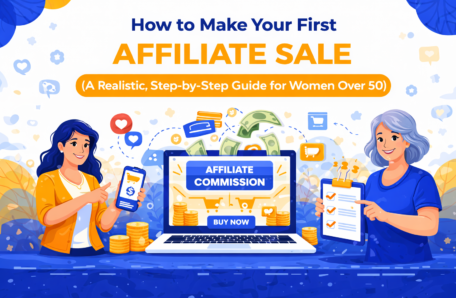
A Realistic, Step-by-Step Guide for Women Over 50
Eight weeks ago, you had an idea.
Maybe it was a quiet thought that arrived one morning over coffee — "What if I could actually make money from a blog?" Maybe it was something a friend mentioned, or a YouTube video you stumbled across, or simply a growing sense that there had to be a better way to supplement your income in retirement than the options you'd been given.
Whatever brought you here — you showed up. You set up your blog. You wrote your first posts. You built your email list. You started showing up on Pinterest.
And now it's time for the moment you've been working toward.
Your first affiliate sale.
I want to be honest with you about something before we begin. Your first affiliate commission probably won't be life-changing. It might be $5. It might be $47. It might be $100. The amount is almost beside the point — because what your first commission actually does is something far more valuable than the money itself.
It proves that this works.
It proves that real people read your words, trust your recommendations, and take action because of something you created. And once you've experienced that — once you've seen that first commission notification arrive in your inbox — something shifts. The abstract becomes concrete. The possible becomes real. And the motivation to keep going becomes almost unstoppable.
This post is going to get you there.
By the end of this post, you will have:
✅ A clear understanding of exactly what needs to be in place before your first sale
✅ A step-by-step action plan for making your first affiliate commission
✅ The specific types of content that convert readers into buyers
✅ The honest truth about what works — and what doesn't
✅ A realistic timeline so you know exactly what to expect
Let's make your first sale.
Quick Navigation:
- The 4 Things You Need Before Your First Sale
- The Mindset Shift That Changes Everything
- The 5 Content Types That Drive Affiliate Sales
- Your First Sale Action Plan — Step by Step
- How to Write a Product Recommendation That Converts
- Where to Place Your Affiliate Links for Maximum Clicks
- The Honest Truth About Conversion Rates
- What to Do After Your First Sale
- Your Action Plan This Week
The 4 Things You Need Before Your First Sale
Before we talk about strategy, let's make sure the foundation is solid. Making your first affiliate sale requires four things to be in place. If any of these are missing, your affiliate links will underperform — no matter how good your content is.
Thing 1: A Blog With at Least 4–6 Published Posts
Your blog needs to look like a real, active, trustworthy resource — not an empty shell with one post and a handful of affiliate links. Before you focus on making sales, make sure you have at least four to six published posts that demonstrate your knowledge, your voice, and your genuine desire to help your reader.
A reader who lands on a blog with one post and three affiliate links will leave immediately. A reader who lands on a blog with eight helpful, well-written posts will stay, explore, and trust your recommendations.
If you've been following this content calendar from Week 1, you already have this covered. Well done.
Thing 2: At Least One Approved Affiliate Program
You cannot earn commissions without being approved for an affiliate program. If you haven't already done this, go back to the Week 4 post on affiliate marketing and choose one program to apply for today.
For your first affiliate sale, I recommend starting with one of these three options — chosen because they are easy to get approved for, relevant to almost any niche, and genuinely useful to your readers:
- Amazon Associates — for physical products in any niche
- SiteGround — for readers who want to start a blog
- MailerLite — for readers who want to build an email list
Thing 3: Proper Affiliate Disclosures in Place
Before you publish a single affiliate link, you must have your disclosure statement in place. This is both a legal requirement and an ethical one — and it actually builds trust with your readers rather than undermining it.
Your disclosure should appear:
- At the top of every blog post that contains affiliate links
- On a dedicated Disclosure page linked in your footer
- In any email that contains affiliate links
Here is a simple, clear disclosure you can use:
"This post contains affiliate links, which means I may earn a small commission if you click a link and make a purchase — at no extra cost to you. I only ever recommend products I genuinely use and believe in. Thank you for supporting this blog."
Thing 4: A Basic Understanding of Your Reader's Needs
The most effective affiliate marketing is not about promoting products. It is about solving problems. Before you recommend any product, ask yourself:
- What specific problem does my reader have right now?
- Does this product genuinely solve that problem?
- Would I recommend this product to my closest friend?
If the answer to all three questions is yes — you have a recommendation worth making. If the answer to any of them is no — find a different product.
The Mindset Shift That Changes Everything
Here is the single most important thing I want you to understand about making affiliate sales — and it has nothing to do with strategy, SEO, or pin design.
Stop thinking about making sales. Start thinking about solving problems.
The bloggers who struggle with affiliate marketing are the ones who approach it like this: "How do I get people to click my links and buy things?"
The bloggers who succeed approach it like this: "My reader has a specific problem. What is the best solution I can point her toward?"
When you genuinely focus on solving your reader's problem — when your recommendation comes from a place of authentic care rather than commission-chasing — your readers feel it. And they respond to it.
Think about the last time a trusted friend recommended a product to you. They didn't give you a sales pitch. They said something like: "I've been using this for three months and it's genuinely changed how I do things — I think you'd love it." And because you trusted them, you probably looked it up.
That is exactly the energy your affiliate recommendations need to carry. Not a sales pitch. A trusted friend's honest recommendation.
When you make that shift — from seller to helper — everything about your affiliate marketing becomes easier, more authentic, and more effective.
The 5 Content Types That Drive Affiliate Sales
Not all blog posts are equally effective at generating affiliate commissions. Some content types are specifically designed to move a reader from "interested" to "ready to buy." Here are the five most powerful ones — with examples you can use immediately.
Content Type 1: The Product Review Post
What it is: A detailed, honest review of a single product — covering what it is, who it's for, what you love about it, any honest drawbacks, and your final recommendation.
Why it converts: People search for reviews before they buy. A genuine, balanced review from a trusted source is one of the most powerful purchase triggers that exists. The key word is genuine — a review that only covers the positives will feel like an advertisement and convert poorly. A review that honestly addresses both the pros and the cons will feel trustworthy and convert extremely well.
Example title: "SiteGround Review 2026: Is It the Best Hosting for Beginner Bloggers?"
Structure:
- What is [Product] and who is it for?
- What I love about it (3–5 specific points)
- Honest drawbacks (1–2 real limitations)
- Who I'd recommend it to — and who I wouldn't
- Final verdict and affiliate link
Content Type 2: The Comparison Post
What it is: A side-by-side comparison of two or three competing products — helping your reader decide which one is right for their specific situation.
Why it converts: Readers who are comparing products are very close to making a purchase decision. They just need help choosing. A well-structured comparison post meets them exactly where they are and guides them toward the right choice — which, ideally, is one of the products you're affiliated with.
Example title: "MailerLite vs ConvertKit vs Mailchimp: Which Email Platform is Best for Beginner Bloggers?"
Structure:
- Brief overview of each product
- Side-by-side comparison table (price, features, ease of use, support)
- Who each product is best for
- My personal recommendation — and why
- Affiliate links for each product
Content Type 3: The "Best Of" Listicle
What it is: A curated list of the best products, tools, or resources in a specific category — for example, "The 7 Best Tools for New Bloggers" or "5 Best Affiliate Programs for Women Over 50."
Why it converts: Listicles are highly shareable, highly searchable, and give you the opportunity to include multiple affiliate links in a single post. They also position you as a knowledgeable curator — someone who has done the research so your reader doesn't have to.
Example title: "The 8 Best Tools I Use to Run My Online Business From Home (All Beginner-Friendly)"
Structure:
- Brief introduction explaining your selection criteria
- Each tool with: what it is, what you use it for, who it's best for, price, and affiliate link
- A summary table at the end
- Your top recommendation for absolute beginners
Content Type 4: The Tutorial Post With Embedded Recommendations
What it is: A step-by-step how-to post that naturally incorporates product recommendations as part of the process — rather than as a separate "here's what to buy" section.
Why it converts: When a product recommendation is embedded naturally within a tutorial — as the tool you use to complete a specific step — it feels like helpful advice rather than a sales pitch. The reader is already following your instructions, so recommending a specific tool feels like a natural extension of the guidance you're already providing.
Example: Your Week 3 post — "How to Start a Blog in 30 Minutes" — is a perfect example of this. The SiteGround recommendation in Step 3 is embedded naturally within the tutorial, making it feel like practical advice rather than promotion.
Content Type 5: The Resource Page
What it is: A dedicated page on your blog — usually linked in your navigation menu — that lists all of the tools, products, and resources you personally use and recommend, organized by category.
Why it converts: A resource page is one of the highest-converting pages on any blog — because it attracts readers who are specifically looking for recommendations. Someone who navigates to your resource page is already in a buying mindset. They want to know what you use and trust.
How to create it:
- Create a new page in WordPress titled "Resources" or "Tools I Use"
- Organize it into categories (e.g., Blogging Tools, Email Marketing, Design, Learning)
- For each resource, write 2–3 sentences explaining what it is and why you recommend it
- Include your affiliate link for each product
- Add this page to your main navigation menu
💡 Pro Tip: Your resource page will likely become one of the most visited pages on your blog over time. Update it regularly as you discover new tools and retire old ones — and make sure every product on it is something you genuinely use and recommend.
Your First Sale Action Plan — Step by Step
Now let's get specific. Here is the exact step-by-step action plan I recommend for making your first affiliate sale — designed to be completed within the next two weeks.
Step 1: Choose One Product to Focus On
Do not try to promote ten products at once. Choose one product — the one you know best, use most regularly, and feel most confident recommending — and focus all of your energy on promoting that single product first.
For most beginner bloggers in the online business niche, I recommend starting with either:
- SiteGround (if your audience includes people who want to start a blog)
- MailerLite (if your audience includes people who want to build an email list)
Both have generous commission structures, are genuinely useful to your readers, and are easy to write about authentically.
Step 2: Write One Dedicated Review Post
Write a detailed, honest review of your chosen product — using the structure outlined in Content Type 1 above. This post should be at least 1,500 words and should cover:
- What the product is and who it's for
- Your personal experience using it
- The specific features you find most valuable
- Any honest limitations or drawbacks
- A clear final recommendation with your affiliate link
This review post will become one of your most valuable long-term assets — continuing to drive commissions for months and years after you publish it.
Step 3: Add Your Affiliate Link to Existing Posts
Go back through your existing blog posts and identify any place where it would be natural and helpful to mention your chosen product. Add a brief mention and your affiliate link in those places.
For example:
- If you wrote a post about starting a blog, add a mention of SiteGround in the hosting section
- If you wrote a post about email marketing, add a mention of MailerLite in the tools section
- If you wrote a post about blogging tools, add your chosen product to the list
This is one of the fastest ways to start generating affiliate clicks — because you're adding links to content that is already being read.
Step 4: Create a Pinterest Pin for Your Review Post
Using the Pinterest strategy from Week 7, create 3–5 pins specifically for your new review post. Use text overlays that speak directly to your reader's decision-making process — for example:
- "Is SiteGround Worth It? My Honest Review After 6 Months"
- "MailerLite Review: The Best Free Email Platform for Beginner Bloggers?"
- "The Hosting Platform I Recommend to Every New Blogger — And Why"
Pin these to your most relevant boards and to your personal blog board.
Step 5: Mention Your Recommendation in Your Email Newsletter
Send an email to your list mentioning your new review post. Keep it personal and conversational — not salesy. Something like:
"This week I published something I've been meaning to write for a while — an honest review of [Product Name], which is the [hosting/email/design] tool I use every single day to run this blog. I've covered everything — what I love about it, what I don't, and whether I'd recommend it to a complete beginner. If you've been wondering whether [Product Name] is right for you, I think you'll find this helpful: [link to review post]"
Step 6: Be Patient — and Keep Creating
After completing Steps 1–5, your job is simply to keep creating helpful content and trust the process. Your review post needs time to be indexed by Google, found on Pinterest, and shared by your email subscribers.
Most bloggers make their first affiliate sale within four to eight weeks of publishing their first dedicated review post — sometimes sooner, sometimes later. The timeline varies enormously depending on your traffic levels, your niche, and the product you're promoting.
What I can tell you with certainty is this: the bloggers who make consistent affiliate income are the ones who keep creating, keep promoting, and keep showing up — even when the results feel slow.
How to Write a Product Recommendation That Converts
The difference between an affiliate recommendation that converts and one that doesn't almost always comes down to one thing: specificity.
Vague recommendations do not convert. Specific, personal, detailed recommendations do.
Here is the difference:
Vague (low converting):
"I use SiteGround for my hosting and it's really good. You should check it out."
Specific (high converting):
"I've been using SiteGround for eight months and the thing I appreciate most is their live chat support. When I was setting up my blog and got completely stuck trying to install WordPress, I opened a chat at 11pm on a Sunday night and had a real, helpful human being walking me through the solution within four minutes. For a beginner who doesn't have a tech background, that kind of support is genuinely invaluable — and it's the main reason I recommend SiteGround over every other hosting provider I've tried."
See the difference? The second recommendation is specific, personal, and story-driven. It addresses a real fear your reader has (getting stuck with no support) and resolves it with a real experience. That is the kind of recommendation that makes people click.
The 4 Elements of a High-Converting Recommendation:
1. Your personal experience — How long have you used it? How do you use it? What specific result has it helped you achieve?
2. A specific feature or benefit — Not "it's easy to use" but "the drag-and-drop email builder means I can create a professional newsletter in under 20 minutes, even though I have no design background."
3. Who it's best for — Be specific about your ideal reader. "This is perfect for you if you're just starting out and want something that won't overwhelm you."
4. An honest limitation — "The one thing I'd flag is that the free plan limits you to 1,000 subscribers — but for a brand new blogger, that's more than enough to get started, and by the time you outgrow it, your blog will be generating enough income to cover the upgrade comfortably."
Where to Place Your Affiliate Links for Maximum Clicks
The placement of your affiliate links within your content matters enormously. Here are the highest-converting placements, in order of effectiveness.
1. Within the Body of a Tutorial (Highest Converting)
When a product recommendation is embedded naturally within a step-by-step tutorial — as the tool used to complete a specific step — it converts better than almost any other placement. The reader is already following your guidance, so the recommendation feels like a natural next step.
2. In a Dedicated Review Post
A reader who searches for "[Product Name] review" and lands on your post is already considering purchasing. Your job is simply to give them the honest, detailed information they need to make a confident decision.
3. In a "Best Of" Listicle
Readers who find a "best tools for bloggers" type post are in research mode — actively looking for recommendations. Multiple affiliate links in a single well-structured post can generate significant commissions.
4. On Your Resource Page
As discussed above — readers who visit your resource page are specifically looking for recommendations. This page consistently generates passive commissions with no additional effort once it's set up.
5. In Your Email Newsletter
A personal recommendation in your email newsletter — sent to people who already know, like, and trust you — converts at a higher rate than almost any other channel. Use it sparingly and authentically.
6. In Your YouTube Video Descriptions
If you're creating YouTube videos alongside your blog, include your affiliate links in the video description and mention them naturally within the video itself.
The Honest Truth About Conversion Rates
I want to give you realistic expectations here — because unrealistic expectations lead to discouragement, and discouragement leads to giving up.
Average affiliate conversion rates for beginner bloggers:
- Click-through rate (the percentage of readers who click your affiliate link): 1%–5%
- Conversion rate (the percentage of people who click and then buy): 1%–3%
What this means in practice: if 100 people read a blog post with an affiliate link, approximately 2–5 of them will click the link. Of those, approximately 1–2 will make a purchase.
This is why traffic matters so much. With 100 monthly readers, you might make one or two sales per month. With 1,000 monthly readers, you might make ten to twenty. With 10,000 monthly readers, the numbers become genuinely significant.
This is also why the quality of your recommendation matters so much. A highly specific, personal, trust-building recommendation can achieve conversion rates of 5%–10% or higher — significantly outperforming the average.
The formula for affiliate income is simple:
Traffic × Trust × Relevance = Commissions
Focus on growing all three — and your income will grow with them.
What to Do After Your First Sale
The day will come — sooner than you think — when you receive a notification that you've earned your first affiliate commission. When that happens, here is exactly what I want you to do.
First: Celebrate. Genuinely. This is a real milestone. You created something, someone trusted your recommendation, and you earned money because of it. That is remarkable — and it deserves to be acknowledged.
Second: Analyze. Look at which post the commission came from, which product was purchased, and how the reader found your content. This information is gold — it tells you exactly what is working and where to focus your energy next.
Third: Double down. Create more content like the post that generated your first sale. Write more reviews of similar products. Create more pins promoting that post. Mention it in your next email newsletter.
Fourth: Diversify. Once you've made your first sale with one product, apply for a second affiliate program and repeat the process. Over time, you want to have multiple income streams from multiple products — so that no single program represents more than 30%–40% of your total affiliate income.
Fifth: Keep going. Your first sale is not the destination. It is the proof of concept. The beginning of something that, with consistent effort and genuine care for your readers, can grow into a meaningful and sustainable income stream.
Your Action Plan This Week
Here is your simple, focused plan for the next seven days.
Day 1: Choose the one product you're going to focus on for your first affiliate sale. Make sure you're approved for their affiliate program and have your affiliate link ready.
Day 2: Write the outline for your dedicated review post — using the structure from Content Type 1 above.
Day 3: Write the first draft of your review post. Don't edit — just write.
Day 4: Edit, format, and add your affiliate disclosure to your review post.
Day 5: Publish your review post. Create 3–5 Pinterest pins for it and schedule them.
Day 6: Go back through your existing posts and add your affiliate link naturally wherever it fits. Create or update your Resource Page.
Day 7: Send an email to your list mentioning your new review post. Keep it personal, warm, and genuinely helpful.
Then — keep creating, keep showing up, and trust the process.
"Your first affiliate commission is not just money. It is proof — proof that your words have value, that your recommendations are trusted, and that the business you are building is real. Hold onto that feeling. It is the fuel that will carry you through every slow week and every moment of doubt that comes after."
📥 [Download Your Free Simple Start Roadmap — Click Here]
📺 [Watch the Companion YouTube Video — Click Here]
💬 Tell me in the comments: Which product are you going to write your first review post about? And if you've already made your first affiliate sale — I want to hear about it! Drop it in the comments below.
Found this helpful? Share it with a blogger friend who's been struggling to make their first affiliate sale. And make sure you're subscribed to the newsletter — every week I send out a new, plain-English guide designed specifically for women like you.